
My name is Diane Perrons. I am Professor Emerita in Feminist Political Economy having spent the last 24 years working at LSE and the preceding 21 at the City of London Polytechnic.
I became a Fellow of the Academy of Social Sciences in 2003 for my role in editing academic journals and for bringing gender issues into economic geography and regional studies. I was promoted to a Chair at LSE in 2007 for work on Globalisation, Gender and Inequality.
My current project focuses on the recent economic crisis and sustainable and equitable alternatives to austerity.
Background
I was born and brought up in Nottingham and am very much a product of a hard working mum, Keynesian economic policies and the UK post-war welfare state: receiving free orange juice; free milk; free school meals; funding for a school uniform and a student grant to go to Bristol University where I studied Geography with Economics. When contrasted with today’s young people I am very conscious of my luck in being born in the pre-Thatcher era when there was a supportive welfare state (albeit partly dependent on a colonial dividend) and a sense of social solidarity that is largely absent in contemporary times.
My sixth form years coincided with the rise of the European student movement and I recall trying to sell left-wing newspapers outside the Raleigh bicycle factory and subsequently marching against Enoch Powell. In 1967 with the late Amajit Johal I published an article in the school magazine which shared the aims of the student movement but also reflected a form of politics aimed at building consensus for what are in effect revolutionary goals of economic and gender justice that has remained with me ever since.
Recent work
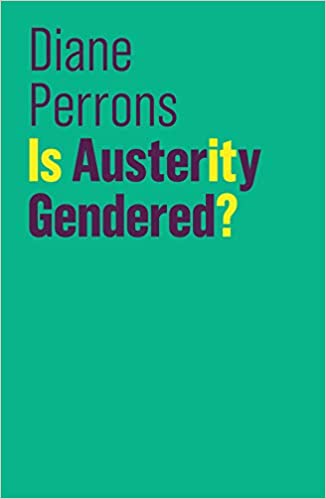
Is Austerity Gendered?
In this incisive analysis, Diane Perrons shows that while austerity policies have devastating effects on people’s lives, their gendered dynamics are particularly conspicuous: budget cuts have been overwhelmingly aimed at services used by women. She shows how the gender aspects of this economic and social catastrophe intersected with a range of other factors, making the experience of austerity very different for different groups – and highly unjust. Not only that, it undermined responses to COVID-19.
She finishes by critiquing the justifications for austerity policies and asks whether there are compelling alternatives that can re-invigorate economies and societies after the pandemic, and avoid a return to austerity. This compelling book will be essential reading for activists, policymakers and students of feminist political economy everywhere.

Gender, Migration and Domestic Work. Masculinities, male labour and fathering in the UK and USA. Basingstoke. MacMillan. By Majella Kilkey, Diane Perrons and Ania Plomien (2013)
As the rich have got richer and households have become busier, demand for commoditized household services has increased. While much is known about maids and nannies, this book is distinctive in focusing on masculinized domestic services.
 Diane Perrons